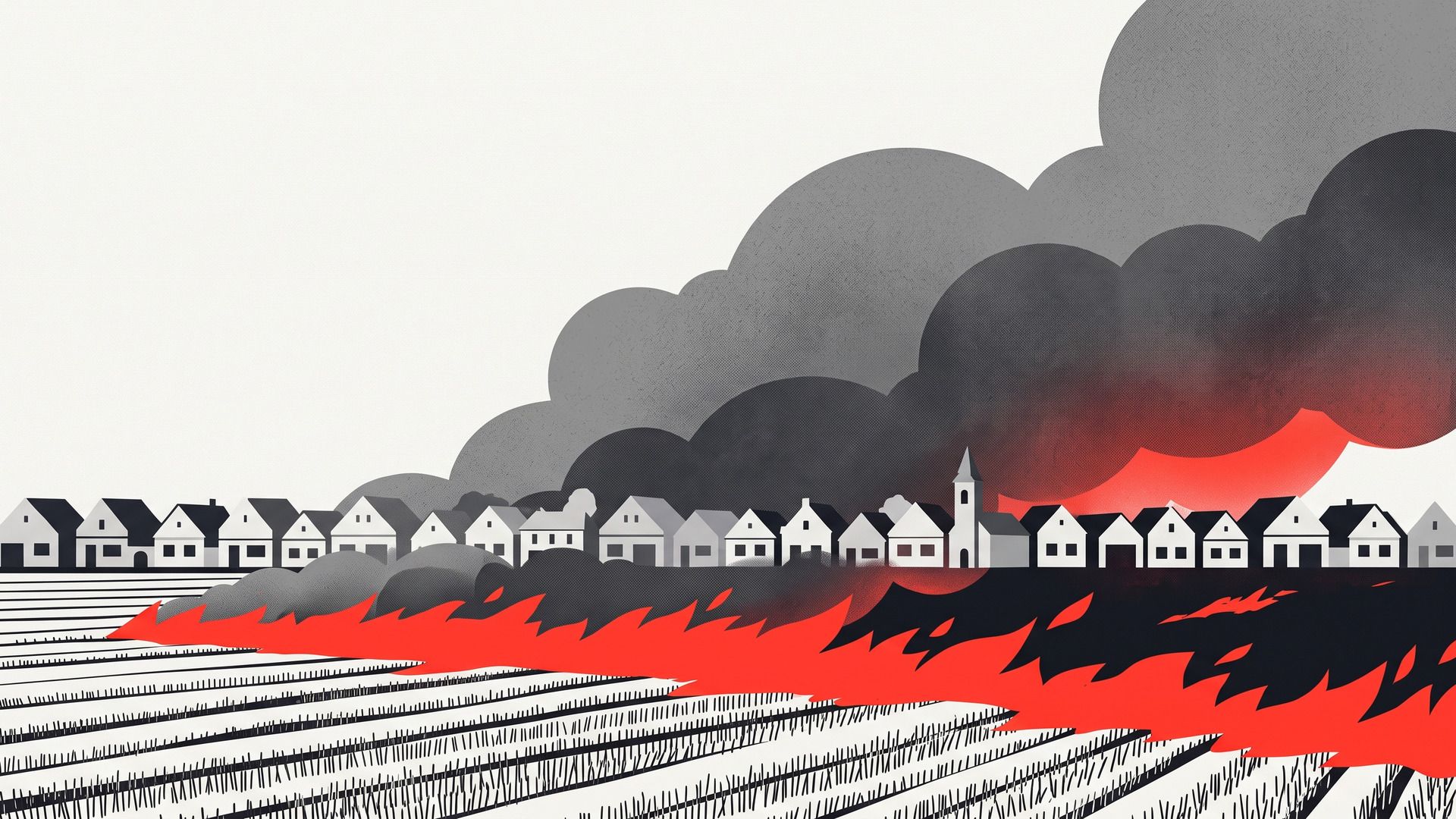
Open-air fires around Sremska Mitrovica, 2021 to 2026
Fire was everywhere. Where were the inspectors?
Translated from the Serbian version of 16 October 2026. The Serbian text is authoritative: Vatra je bila svuda. Gde su bile inspekcije?
Awaiting reply: Five of nine institutions have answered and the court sent its four decisions; the Ministry of Agriculture has until 2 November 2026, three missed the deadline.
Next step: the Ministry of Agriculture's answer, deadline .
Fields around Sremska Mitrovica burn every year; in September 2026 the smoke hung over the villages for days. The author sent nine freedom-of-information requests asking what the institutions recorded about the fires, reports, penalties and air pollution in 2021 to 2026, and who answered for them. The replies and the court's decisions are published in full.
In brief
According to media reports, from 18 to 23 September 2026 open-air fires spread across the farmland around Sremska Mitrovica: Laćarak, Čalma, Manđelos, Grgurevci, Veliki Radinci and Kuzmin. Mostly stubble and low vegetation burned; the fire reached the cemetery in Čalma and the vineyards above Laćarak, and for days the smoke drifted over the villages, the town and the motorway near Kuzmin.
This was no exception. The Sremska Mitrovica Fire and Rescue Battalion reported that from 1 January to 17 September it had responded to 1,109 fires, 901 of them in the open. Radio-Television of Vojvodina reported on 22 September that there had been more than 200 open-air fires in Srem since the start of September alone.
Earlier years were no different. The emergency management department in Sremska Mitrovica recorded 773 open-air fires in 2022 and 936 in 2023, and in early 2024 its head said most of them were fires in the fields, caused by illegal stubble burning. In 2024 more than 800 open-air fires were reported in Srem. As far back as 2018, 283 open-air fires were counted in Srem in five autumn weeks, and the city administration said then that appeals were not working and a field-guard service was not feasible. In those same years, four cases reached the Misdemeanour Court.
There is a ban. Burning stubble and crop residues is prohibited by the Law on Fire Protection and the Law on Agricultural Land. The fine for an individual under the Law on Fire Protection is a fixed 10,000 dinars. For this offence the law provides only a penalty notice, written on the spot by a police officer or inspector, like a parking fine; a court comes in only if the person fined objects. As early as October 2025 the Ministry of Agriculture, Forestry and Water Management announced that it sees every burned plot on satellite images, and that burning without reporting the fire within seven days puts a farm into passive status in the farm register.
If all this is enforced, the figures should show it. That is why Živko Gvozdenović, the author of this site, sent nine freedom of information requests on 23 September 2026 to every institution that puts out the fires, looks for those who start them, files charges, judges, pays subsidies or measures the smoke. By 16 October five of the nine had answered, the Ministry of Agriculture had extended its own deadline, and three were silent. This is what the documents prove.
The court fined no one. From 2021 to 2026 four cases over burning reached the Misdemeanour Court: two were discontinued, two ended in acquittals, not one fine was imposed or collected, and not one penalty notice for burning was contested before the court. The court's reply and all four decisions.
The only field fire that reached a court failed on the wrong piece of paper. A farmer from Kukujevci admitted setting fire to stubble from which the flames spread to two neighbours' corn; instead of a penalty notice, the only instrument the law provides for this offence, the prosecutor filed a request to the court, so the court discontinued the case without ruling on guilt. Decision PR-1095/22.
The other two cases failed on the police's side. In one, nobody from the inspection went to the scene, so the offence was not proven; in the other, the request did not even describe the offence, the court gave ten days to correct it, and no correction came. Judgment PR-493/23 and judgment PR-2752/23.
The "automatic passive status" has reached no farm. A year after the Ministry announced it, the Agrarian Payments Administration says that from 2021 to 2026 not one farm in the City was put into passive status for burning, and that the two inspection reports it received in 2026 were against unknown persons. The Administration's reply.
The City did not apply its own decision. The field-guard service under its 2014 decision did not exist for a single day since 2021, the City has no separate act on burning, not one document on the drones it announced, and in five annual reports of its inspections fires are not mentioned. The City's reply with its annexes.
The institutions knew. A representative of the Emergency Management Sector told the City Emergency Headquarters in February 2025 that more than 800 open-air fires had been reported in Srem the year before, and the head of the emergency management department called the burning of crop residues the biggest problem in May 2026. The Headquarters adopted a prevention plan every year. That a field-guard service was not feasible, the city administration had said as far back as 2018. The Headquarters' minutes.
No one can separate the fires in its own records. The prosecutor's office does not know how many of its complaints concerned fires, the Agrarian Payments Administration kept no record before 2026 because no rule requires one, and the City has no figures on citizens' reports. The Province says it has neither competence nor data. The prosecutor's reply, the Province's reply.
My conclusion: between hundreds of fires a year, by the police's own count, and four cases before the court lies a gap that no document explains. The one body that could explain it, the Ministry of the Interior, has not answered. Either penalty notices for burning were never issued, or none was ever contested; in both cases the one instrument the law provides for this offence was not used where it mattered. The announcements of 2025 and 2026, satellites, passive status and drones, have on the documents produced nothing in Sremska Mitrovica so far.
What I do not know: how many penalty notices the police issued, how many fires they attended and how many perpetrators they identified, because they have not answered; what the air measurements show, because neither the Agency nor the Institute has answered; what the Ministry's satellites recorded here, because the Ministry extended its own deadline to 2 November. And one caveat: a penalty notice paid without objection never reaches a court, so the court's zero is not proof that no notice was ever issued.
What next: the nearest deadline expires on . Every answer will be published here in full. An institution that does not answer will face a complaint to the Commissioner for Information of Public Importance and Personal Data Protection.
Key documents
Each document has a permanent number and its own page, in Serbian, with the scan and the file's SHA-256 hash. The titles and lines below are an unofficial translation.
- D40Freedom of information request: Misdemeanour Court in Sremska Mitrovica, UE 12/2026(page in Serbian)
Number of misdemeanour cases for burning stubble under the Law on Fire Protection and the Law on Agricultural Land, who brought them, how they ended (fine, warning, acquittal, statute of limitations) and how many fines were collected, by year, 2021–2026.
- D41Freedom of information request: Ministry of the Interior, Emergency Management Sector and Sremska Mitrovica Police Department, UE 13/2026(page in Serbian)
Number of open-air fire callouts, on-site investigations, identified perpetrators and misdemeanour charges by year, separately for 18–23 September 2026, plus the number of police criminal complaints for causing general danger.
- D42Freedom of information request: Ministry of Agriculture, Forestry and Water Management (agricultural inspection), UE 14/2026(page in Serbian)
Number of plots around Sremska Mitrovica where burning was detected by satellite, by cadastral municipality, the number of inspections and charges, the number of farms put into passive status, and copies of orders for targeted inspections.
- D43Freedom of information request: City of Sremska Mitrovica, UE 15/2026(page in Serbian)
Whether the field-guard service under the City's 2014 decision ever existed and who ran it, what the municipal police and inspectors did, the minutes of the City Emergency Management Headquarters, and whether the announced decision on drones exists on paper.
- D44Freedom of information request: Basic Public Prosecutor's Office in Sremska Mitrovica, UE 16/2026(page in Serbian)
Number of criminal complaints for causing general danger (Article 278 of the Criminal Code) over open-air fires, who filed them and how they ended, and whether any case was opened over the September fires.
- D45Freedom of information request: Provincial Secretariat for Agriculture, Water Management and Forestry, UE 17/2026(page in Serbian)
Whether the Secretariat inspects burning, whether it holds data on burned plots in Srem, and whether it has funded any measure against stubble burning in Sremska Mitrovica.
- D46Freedom of information request: Agrarian Payments Administration, UE 18/2026(page in Serbian)
Number of active farms in Sremska Mitrovica against those put into passive status for burning, the amount of subsidies withheld, fire reports in eAgrar, and the internal procedure for the “automatic passive status” the Ministry announced.
- D47Freedom of information request: Environmental Protection Agency, UE 19/2026(page in Serbian)
Hourly and daily PM10 and PM2.5 values from state network stations in and around Sremska Mitrovica for 15–30 September 2026 and for the 2021–2025 harvest seasons, the number of days over the limit, and whether the Agency has ever linked field fires to air pollution in Srem.
- D48Freedom of information request: Institute of Public Health Sremska Mitrovica, UE 20/2026(page in Serbian)
Monthly air quality reports the Institute prepares for the City, daily soot values for 15–30 September 2026, exceedances in the 2021–2025 harvest seasons, and whether the Institute warned anyone during the fires.
- D50Reply from the Misdemeanour Court in Sremska Mitrovica to freedom of information request UE 12/2026, no. SU II 17a 17/26(page in Serbian)
Since 1 January 2021 the court, with its department in Šid, received four requests to open misdemeanour proceedings under Article 84 of the Law on Fire Protection: two in 2022, both discontinued, and two in 2023, both ending in acquittals. There were no requests under Article 82 of that law or under the Law on Agricultural Land, no requests for a court decision on a penalty notice, and no fines were collected. Signed by a judge as the authorised officer.
- D51Supplementary freedom of information request: Misdemeanour Court in Sremska Mitrovica, UE 28/2026(page in Serbian)
Anonymised copies of the four decisions named in the court's reply SU II 17a 17/26; for each case the date of the offence, of the request and of the decision; the legal ground for the two discontinuations, the reason for the two acquittals, and whether any decision was appealed.
- D53Notice from the Ministry of Agriculture, Forestry and Water Management (Agricultural Inspection Sector) extending the deadline for request UE 14/2026, no. 004263885-2026-14840-004-006-041-001(page in Serbian)
The Ministry will answer request UE 14/2026 (D42) within 40 days of receipt instead of 15, citing the volume of work and Article 16(4) of the freedom of information law. Received 23 September 2026, so the last day is 2 November 2026. Signed by hand by the authorised officer of the Agricultural Inspection Sector.
- D54Reply from the Basic Public Prosecutor's Office in Sremska Mitrovica to freedom of information request UE 16/2026, PI no. 21/2026(page in Serbian)
Criminal complaints for causing general danger (Article 278 of the Criminal Code) by year, with the caveat that the office's software cannot filter open-air fires, so these are all complaints under that article: 8 in 2021, 8 in 2022, 8 in 2023, 2 in 2024, 5 in 2025 and none in 2026, almost all filed by the police; three final convictions in five years. In 2026 the office received one notice of stubble burning, on 30 September 2026 by the Ruma–Šimanovci road, after a chain collision; the police were ordered to find the owner of the plot. Signed by the chief public prosecutor.
- D55Reply from the Agrarian Payments Administration to freedom of information request UE 18/2026, no. 004413151-2026-14846-008-003-041-001(page in Serbian)
Farms from the City of Sremska Mitrovica in the farm register by year, 2021 to 2026 (6,281 to 7,084 in total, 5,810 to 6,584 active). Not one was put into passive status for burning crop residues. In 2026 the Administration received two inspection reports, both against unknown persons, so it could not act; for earlier years it keeps no such record, because the farm register rulebook does not require one. No subsidies were withheld and no fire was reported through eAgrar. The rulebook names burning as a ground for passive status but prescribes no procedure. The rulebook (Official Gazette 25/2023) was attached; it is a published regulation and is not reproduced here. Signed by hand by the authorised officer.
- D56Reply from the City of Sremska Mitrovica to freedom of information request UE 15/2026: letter from the City Administration for Culture, Sport and Youth no. 004252651-2026-08926-009-000-041-001 with the answers of three city administrations and the mayor(page in Serbian)
The City answered through its administration for culture, sport and youth. Agriculture (pp. 2 and 3): the field-guard service under the City's 2014 decision was not organised at any time from 1 January 2021 to the request, so there are no monthly reports and the City could not act under it; the City has no separate act on burning; the consolidated decision is attached (D58). Communal and inspection affairs (p. 4): not competent for penalty notices, since supervision of the fire protection law belongs to the Ministry; the communal police received one report in 2024, in 2025 the administration notified the Ministry of the Interior of fires on certain plots, in 2026 the communal inspection forwarded two reports; no figures for the 48-hour system; annual reports attached (D60 to D64). General affairs (pp. 5 and 6): forwards excerpts from the minutes of the City Emergency Headquarters of 25 February 2025, 13 February 2026 and 28 May 2026 and three conclusions (D59); after 28 May 2026 the Headquarters held no session on open-air fires. The mayor (p. 7), on the announced decision on drones: the City holds no document with the information asked for. Four of the five letters are signed electronically; one by hand.
- D57Reply from the Provincial Secretariat for Agriculture, Water Management and Forestry to freedom of information request UE 17/2026, no. 004469958-2026-09419-009-000-041-001(page in Serbian)
The Secretariat does not inspect the application of the Law on Agricultural Land, neither as its own nor as a delegated task; it holds no data on burned plots or fires on farmland in the Srem district or the City; in 2025 and 2026 it sent no letters, instructions or recommendations on stubble burning to local governments, extension services or the Ministry; and it refers the requester to the Ministry of Agriculture. On item 3 (measures funded against burning) it answers that no subsidies were granted to voluntary fire brigades in the City from 2021 to 2026. Electronic seal; signed by authorisation of the provincial secretary by the acting under-secretary.
- D66Reply from the Misdemeanour Court in Sremska Mitrovica to supplementary freedom of information request UE 28/2026, no. SU II 17a 17/26-1(page in Serbian)
Cover letter sending the four decisions asked for in UE 28/2026 (D51): decisions PR-1006/22 and PR-1095/22 of the Šid department (D67, D68) and judgments PR-493/23 and PR-2752/23 (D69, D70). Signed by a judge as the authorised officer.
Full documentation (in Serbian)
The complete case, with every claim labelled as document, my testimony ormy conclusion, the chronology, all documents and the log of corrections, is on the Serbian case page. Paragraphs there have permanent numbers (¶ 1.14 is the fourteenth paragraph of part one); please cite those. A browser's translate function gives a rough reading; the Serbian wording is what counts.